
Organised by
Finance Department, Govt. of Telangana
In Collaboration with
Centre for Economic and Social Studies (Hyderabad)
Date: 25.02.2026
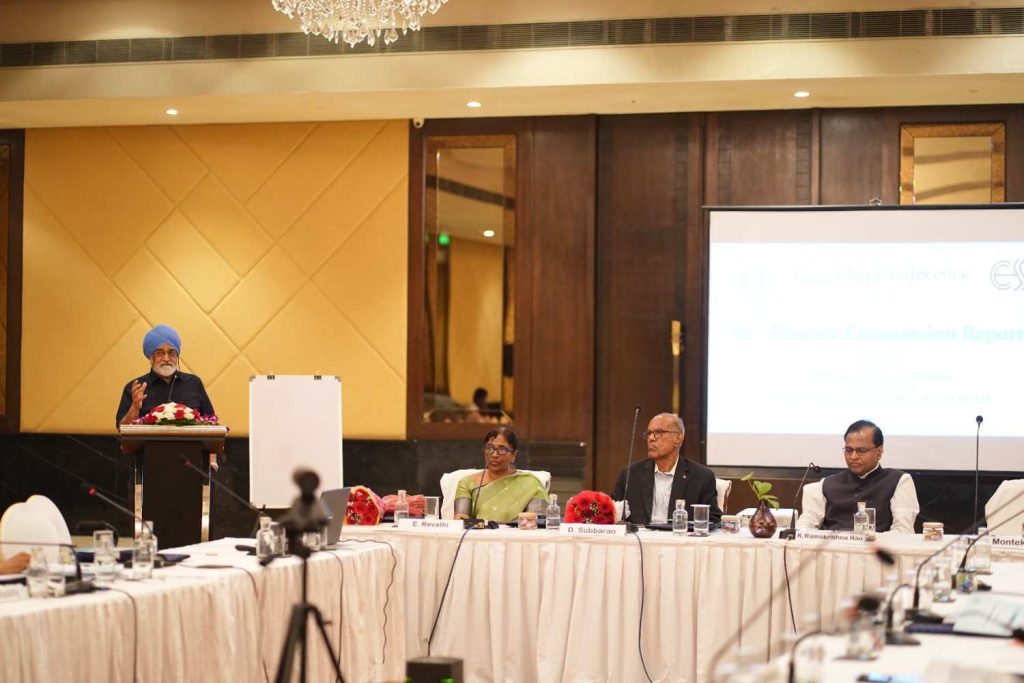
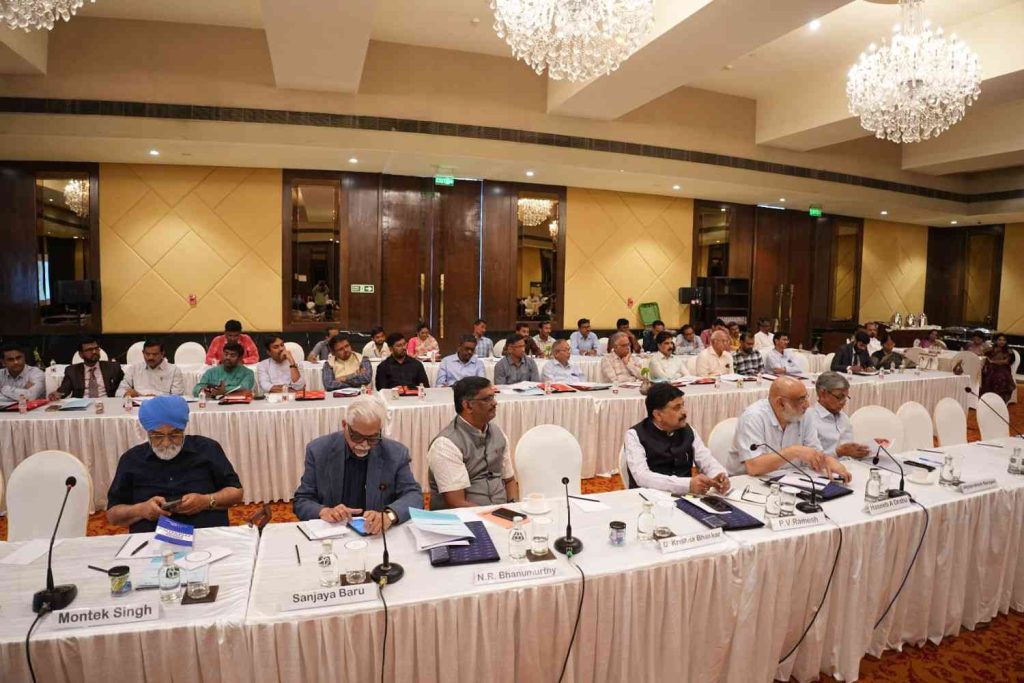
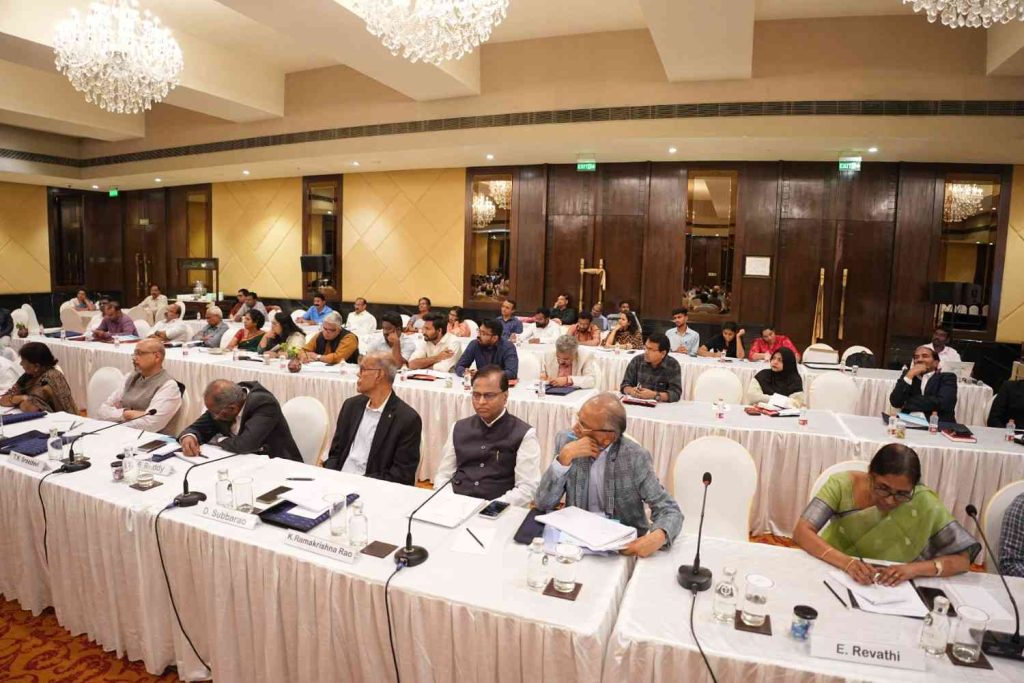
A high-level one-day conference on the Sixteenth Finance Commission was organised at Taj Deccan, Hyderabad, bringing together leading policymakers, economists and senior government officials to deliberate on India’s evolving fiscal federalism and centre–state financial relations.
Prof. Revathi, Director, CESS, opened the inaugural session by welcoming the dignitaries, academics, policymakers, journalists, and representatives from various government departments. She highlighted the conference’s objective: to create a platform for debating the recommendations of the Sixteenth Finance Commission and their implications for states such as Telangana. She underlined that the conference seeks to foster informed discussion among practitioners, scholars and the media on key issues in public finance, including fiscal devolution, state finances and fiscal reforms.
The session was chaired by Sri K. Ramakrishna Rao, the Chief Secretary of the Government of Telangana. In his address, he stressed that the Finance Commission’s report has raised important questions about fiscal consolidation, off-budget borrowings, and the growing burden of subsidies at the state level. He drew attention to the innovative proposals on loss-making public sector enterprises, the need to curb off-budget borrowings, particularly in states like Telangana and the pressures that indiscriminate subsidy schemes place on capital expenditure and long-term development. Also, noted the significance of the Commission’s observations on cesses and surcharges and their impact on the real fiscal space available to states.
Delivering the inaugural address, Dr D. Subba Rao, former Governor of the Reserve Bank of India, described India’s federal structure as a “story of remarkable resilience” when compared with the experience of other federations facing separatist and ethnic tensions. He made three major points: First, that India’s unique “union of states” model has successfully blended unitary and decentralised features, enabling it to manage deep diversity; Second, that state finances now occupy the centre of gravity in India’s macroeconomic management, given that states account for about sixty per cent of public spending and a large share of public borrowing; and Third, the growing cleavage between the Union and the states, manifest in constrained spending autonomy, borrowing limits and resource-raising powers, must be urgently addressed to sustain growth.
Dr Subba Rao also characterised the Sixteenth Finance Commission as a “textbook” commission that largely adhered to its constitutional mandate while still innovating, notably by incorporating contribution to GDP as a factor in the devolution formula.
The keynote address, delivered by Dr Montek Singh Ahluwalia, former Deputy Chairman of the Planning Commission, situated the current debate in the historical evolution of India’s federal and planning architecture. Endorsing many of Dr Subba Rao’s concerns, he argued that the Finance Commission institution itself was designed in a very different political and economic era and now needs to be re-examined for fitness of purpose in a market-oriented, globally integrated India. Dr Ahluwalia emphasised the need to confront the unchecked growth of cesses, to revisit the distribution of subjects across the Union, State and Concurrent Lists and to think more boldly about issues such as delimitation, the size of states, and genuine devolution to local governments.
He also highlighted the chronic under-utilisation of state-level taxing powers, particularly in property taxation. He argued that weak urban local body finances are a significant constraint on urban infrastructure and investment competitiveness.
Both Dr Subba Rao and Dr Ahluwalia warned against a drift from cooperative and healthy competitive federalism towards “combative” federalism. They called for a new, broad-based national conversation, grounded in comparative international experience, on recalibrating India’s fiscal federal architecture.
Key Takeaways in the Conference:
- The structure of the economy is changing, but the Terms of Reference of Finance Commissions are not changing. Similarly, while the taxation system has changed with the GST, the divisible pool formula remains largely unchanged.
- Cesses and Surcharges are not included in the divisible pool. The divisible pool is shrinking due to the Union government’s overuse of cesses and surcharges. There is a lack of transparency on the use of cesses and surcharges.
- The conference highlighted the high dependency on GDP metrics, and inadequate consideration of population dynamics, broader fiscal measures and state-specific performance indicators. The economy is modernising, but the data has not improved and expanded to reflect it.
- Revenue deficit must be on the basis of the state’s specific needs, and not doing away with it completely.
- There is a chronic underutilisation of the state’s taxing powers, especially property taxes. Weak urban finances constrain urban infrastructure and competitiveness.
- There is an urgent need for clear and uniform definitions of subsidies to enable comparable statistics across states.
- There is a need to bring out annual publications of statistics of local bodies, timely conduct of local body elections, and mandatory action within six months where problems are identified.
- There is a need for better expenditure efficiency metrics, fiscal discipline safeguards and addressing structural deficits in vulnerable states.
- Public sector utility pricing is inevitable for a sustainable public sector.
- The conference underscored that India’s fiscal federal architecture stands at a pivotal moment, with participants converging on the need for deeper transparency, stronger institutions and renewed Centre–State dialogue to ensure that the Sixteenth Finance Commission’s framework supports both national growth and state-level development priorities.