
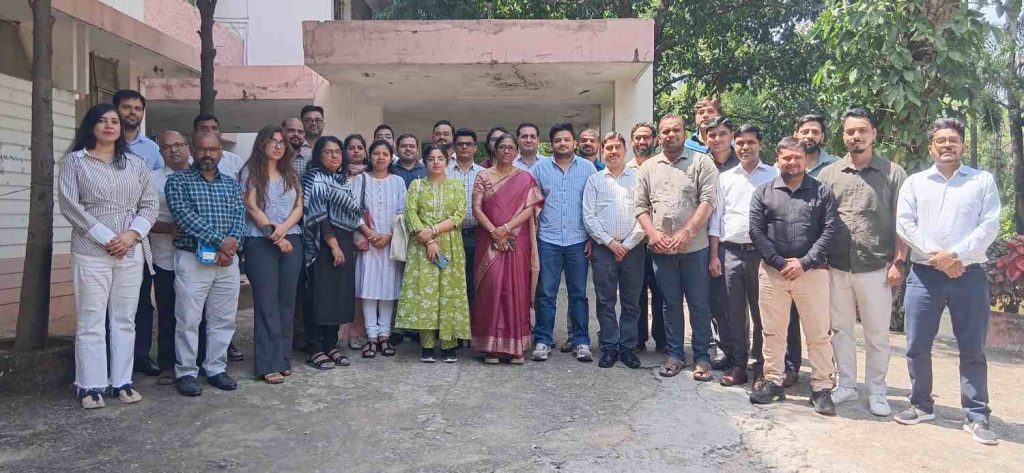
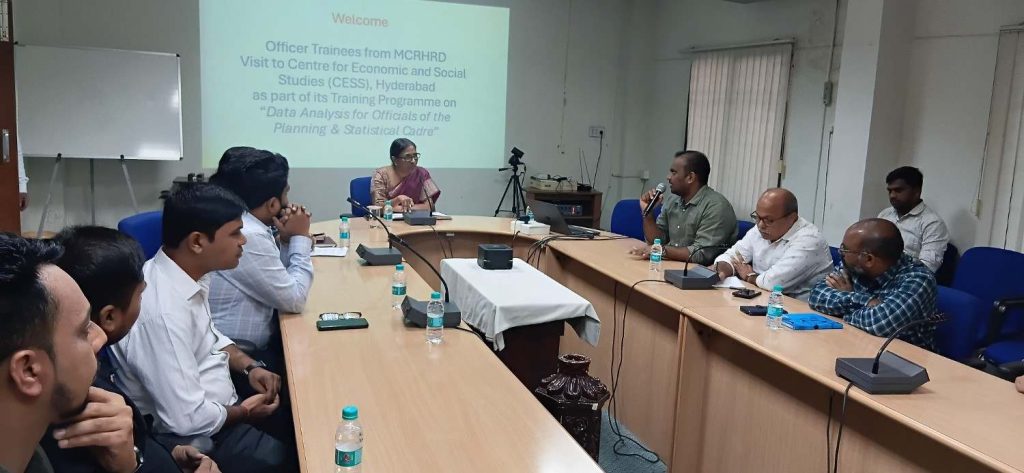
A team of Officer Trainees from the Planning & Statistical Cadre, Government of NCT of Delhi, undergoing a two-week Refresher Training Programme on “Data Analysis for Officials of the Planning & Statistical Cadre” at the Dr. MCR Human Resource Development Institute of Telangana, visited the Centre for Economic and Social Studies (CESS), Hyderabad, on 1 October 2026.
The interaction commenced with the Officer Trainees introducing themselves and sharing their professional responsibilities, areas of work and contributions in their respective departments. The participants represented various departments such as the planning department, statistical services, health, and education departments, infrastructure projects, Information Technology, monitoring and other government departments. Some of the officers were associated with the Planning Department of the Government of Delhi, the Delhi Secretariat, and State Support Teams working in areas related to NITI Aayog and Viksit Bharat initiatives.
The Officer Trainees also shared their experiences in handling government projects, budget preparation and budget estimates, planning, monitoring, public works, industry and IT-related activities, as well as health services and government hospitals. Some participants were engaged in statistical analysis of health records and business data, with academic backgrounds including doctoral studies in Statistics.
Prof. E. Revathi, Director, CESS, briefed the participants about the Centre, its research activities and ongoing research projects. She highlighted the interdisciplinary nature of development studies and the importance of integrating research with policy and governance. She also discussed the relevance of urbanisation in Telangana and India and highlighted public finance as an important connecting area between the research at the centre and the state.
Prof. Revathi also spoke about studies undertaken at CESS in areas such as agriculture, food security, rural development, industry, service sector, education, health, tribals and migration, including migration from Telangana to Middle Eastern countries. She emphasised the importance of strengthening the connection between research and policy implementation and noted that identifying and addressing gaps between research findings and policy processes remains an important challenge for researchers and policymakers.
Prof. Jeena T. Srinivasan, Dean, Division for Graduate Studies (DGS), CESS, briefed the participants about the activities of the DGS and the Ph.D. programme at CESS. She informed that around 50 scholars are currently pursuing their Ph.D. programmes, with Economics being the largest domain among the disciplines represented.
The interaction also focused on the role of data in policy-oriented research and government programmes. The Directorate of Economics and Statistics was discussed in the context of the systematic collection, compilation, analysis and interpretation of data for planning and policymaking. The participants discussed the use of data from areas such as agriculture, paddy procurement and civil supplies for analytical studies.
The discussion on migration highlighted the importance of collecting and validating primary data through sample surveys and validating it with relevant secondary data. The participants also discussed return migration and its relationship with livelihoods and agriculture, including the context of Mahabubnagar district and the role of irrigation and related infrastructure in the region.
The interaction further covered the experiences of the Government of Telangana in extending support to families of persons migrating to Middle Eastern countries. The discussion provided an opportunity to examine how administrative data, field-level information and research evidence can contribute to understanding such issues and strengthening policy responses.
The interaction between the Officer Trainees and the faculty of CESS provided a platform for exchanging perspectives on data analysis, development research, public policy, planning and evidence-based research. The discussions highlighted the importance of strengthening the linkage between statistical evidence, academic research and policy implementation.