

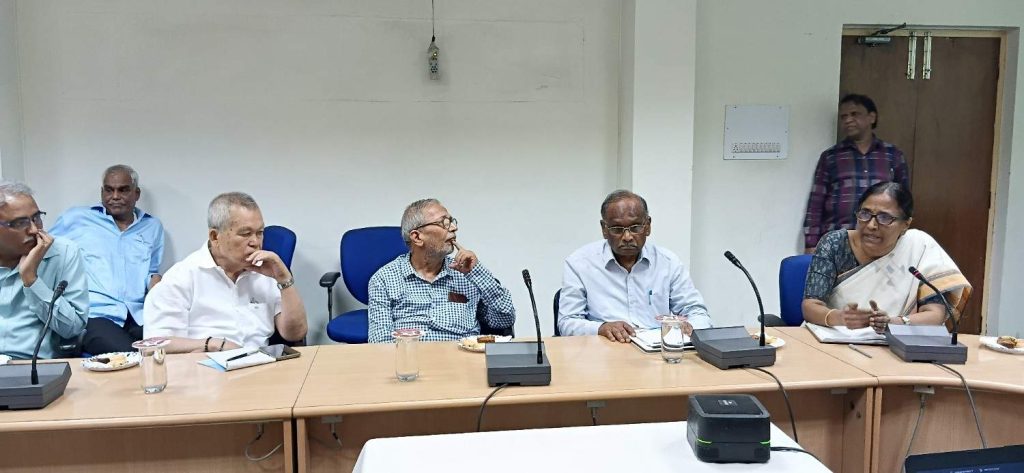
Faculty seminar was organised on 29th May at 11.30 am on the theme “SOCIO-ECONOMIC IMPACT OF GST 2.0 REFORMS ON HOUSEHOLD CONSUMPTION IN TELANGANA”. The seminar was given by Mr. G. Thiloth Rao, Research Scholar, CESS, Dr. V. Vijay Kumar, RBI Fellow, CESS, Dr. E Revathi, Professor & Director, CESS. The seminar was chaired by Prof. E. Revathi, Director, CESS. Ms. Rupa Sowmya, Joint Commissioner, Commercial Tax Department, is the discussant for the paper. Dr. G. R. Reddy, Founder member, Board of Governors, CESS, also graced the occasion. CESS faculty, research scholars and Summer Interns have participated in the seminar. The academic session was highly interactive, enriching the discussions on the theme. Presenters have effectively clarified the issues raised by the participants. Key suggestions were given for strengthening the paper.
Abstract of the Presentation:
Introduced in 2017 to replace India’s fragmented multi-tax system, the Goods and Services Tax (GST) established a unified value-added tax framework. In August 2025, GST 2.0 reforms further rationalised the complex four-tier structure into a streamlined two-rate system (5 per cent merit and 18 per cent standard) to enhance affordability and simplify compliance. This study evaluates the socio-economic impact of these reforms on Telangana’s consumption patterns using NSSO Household Consumption Expenditure Surveys (2022-2024). Findings indicate that Telangana’s effective household GST burden is projected to decline in the range of 5.4-10.4 per cent to 3.9–7.1 per cent. The reforms maintain progressivity; essential food items see significant relief (projected at 0.9–3.4 percent). Among all households, female-headed households in Telangana are slated for the nation’s lowest effective rates (3.3–6.1 per cent). While high-capacity private transport faces higher tax ceilings, the overall strategy prioritises citizen-centric relief. However, the evidence also shows the persistence of macroeconomic counter-pressures. For example, sharp inflationary trends in service-oriented sectors—notably education (39 per cent) and health (21 per cent)—threaten to overshadow these tax savings. The study concludes, acknowledging limitations, that while GST 2.0 acts as a vital buffer, it may only slow price increases rather than lowering the absolute cost of living for consumers.