
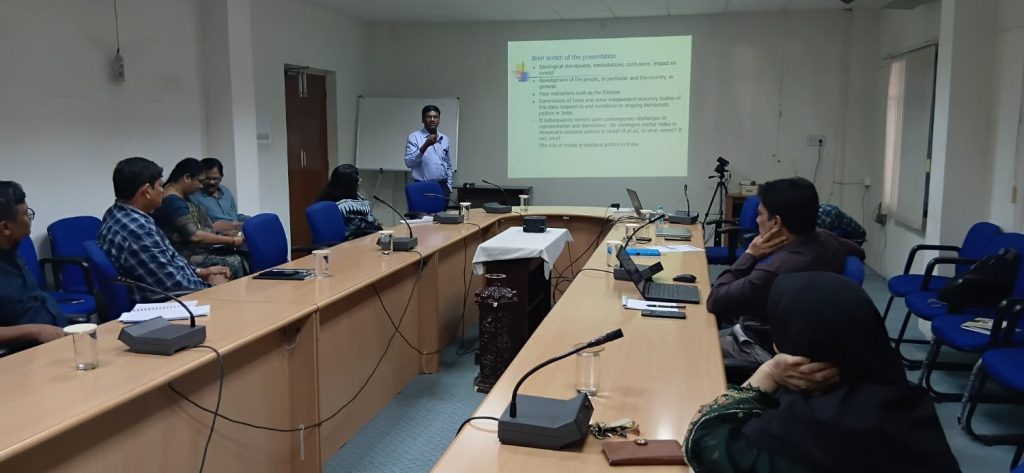
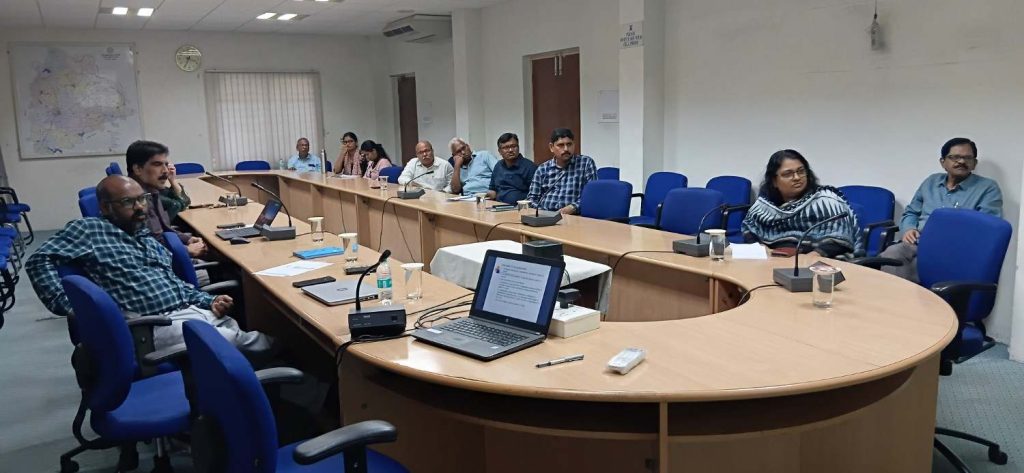
CESS-DGS organised a Special Lecture on “Democracy, Representation and Dynamics of Electoral Politics in Contemporary Times: Critical Reflections” on 1 October 2026.
The lecture was delivered by Dr. Jagannatham Begari, Associate Professor, Department of Gandhian Thought and Peace Studies, School of Social Sciences, Central University of Gujarat.
The lecture critically examined the changing dynamics of democracy, political representation and electoral politics in contemporary India. The discussion focused on ideological standpoints, contestations and their implications for democratic politics and development, along with the role of institutions such as the Election Commission of India and other independent statutory bodies in shaping democratic processes.
The lecture also explored the concept of political representation, including the relationship between representatives and those they represent, and discussed perspectives associated with B.R. Ambedkar, Nancy Fraser, John Rawls and Amartya Sen in relation to representation, recognition and redistribution.
Further, the lecture addressed contemporary challenges to Indian democracy and electoral politics, including the crisis of representation, governance, political communication, the role of civil society and the changing nature of political participation. It also examined the role of traditional, electronic, print and social media, including emerging digital platforms, in electoral politics and democratic communication.
The lecture also discussed emerging issues concerning Artificial Intelligence and electoral politics, including its potential role in voter facilitation, accessibility, logistics, data-informed decision-making and communication between institutions and citizens, while highlighting the need for ethical safeguards and informed deliberation.
Another important area of discussion was the growing participation of Generation Z in Indian politics, particularly their engagement through social media, digital platforms, public discussions and social movements. The lecture considered issues such as unemployment, education, social justice, economic inequality, political representation and freedom of expression in relation to youth participation in democracy.
The lecture concluded by reflecting on the way forward for democratic and electoral politics, emphasising people-centric and development-oriented representation, dialogic forms of deliberation, and greater consideration of the aspirations and participation of younger generations.