
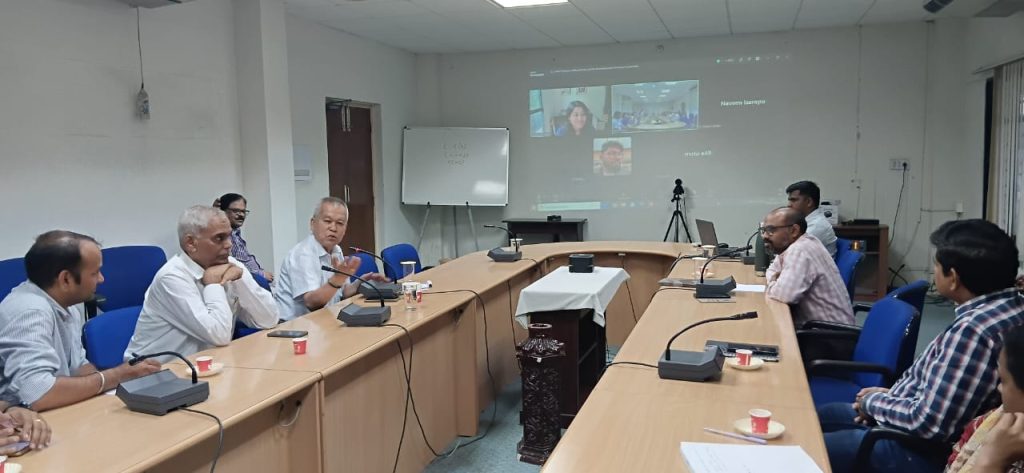
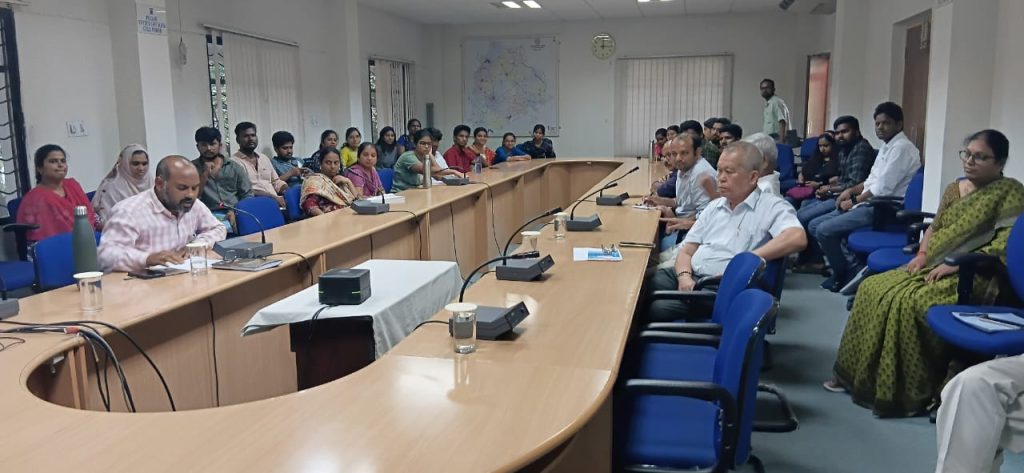
The CESS-DGS organised a guest lecture on “Surface Tensions: Roads, Potholes and the Embodied Politics of Driving in Urban India” on 15 May 2026. The lecture was delivered by Dr. Sneha Annavarapu, Assistant Professor, National University of Singapore, who shared insights from her ongoing research and book project titled “On the Move: The Politics of Driving in India.” The session examined the socio-political, infrastructural, and embodied dimensions of urban mobility, with a particular focus on potholes, road conditions, and inequalities experienced by commuters in Indian cities, especially Hyderabad.
The lecture commenced with introductory remarks by Dr. Srinivas Junuguru, who welcomed the speaker and highlighted the relevance of the topic in the context of rapidly urbanising Indian cities. He briefly introduced Dr. Sneha Annavarapu’s academic work and emphasised the importance of studying roads and mobility through an ethnographic and experiential lens. The session was presided over by Prof. Amar Yumnam, who underlined the significance of road management and urban infrastructure in shaping everyday life in Hyderabad.
In her lecture, Dr. Sneha Annavarapu discussed how roads and potholes are not merely technical or civic issues but are deeply connected to questions of inequality, governance, corruption, class, caste, gender, and urban development. Drawing upon ethnographic methods such as participant observation, interviews, field notes, and interpretative analysis, she explained how different groups—including motorists, autorickshaw drivers, traffic police, volunteers, and residents—experience roads in unequal ways. The lecture highlighted that potholes disproportionately affect individuals who cannot afford vehicles with smoother suspension systems, thereby producing uneven physical and sensory experiences across social groups.
The speaker elaborated on how Hyderabad’s rapid urban expansion, particularly since the development of the IT corridor and HITECH City, has resulted in uneven road infrastructure and maintenance across different parts of the city. While affluent localities and VIP areas often enjoy better roads, several neighbourhoods continue to face deteriorating road conditions. Through narratives collected during fieldwork, the lecture illustrated how potholes have become symbols of corruption, uneven governance, and infrastructural neglect. The discussion also explored how citizens increasingly rely on social media, humour, and civic activism to draw attention to road-related problems.
The lecture further addressed the broader social implications of poor road infrastructure, including road accidents, physical discomfort, gendered experiences of mobility, and accessibility challenges. She highlighted that women drivers and passengers often encounter issues related not only to road conditions but also to safety and harassment in public spaces. The session also explored the experiences of gig workers, autorickshaw drivers, and marginalised communities, highlighting how infrastructural inequalities perpetuate broader forms of social inequality in urban life.
An interactive discussion followed the lecture, during which participants raised questions on urban infrastructure, unequal experiences of mobility, road safety, gendered dimensions of driving, and possible measures for improving road conditions in cities.
The session concluded with remarks by Prof. Amar Yumnam, who summarised the major themes discussed during the lecture and reflected on how roads and potholes reveal deeper realities of urban life, inequality, and the lived experiences of citizens in rapidly growing cities like Hyderabad.