
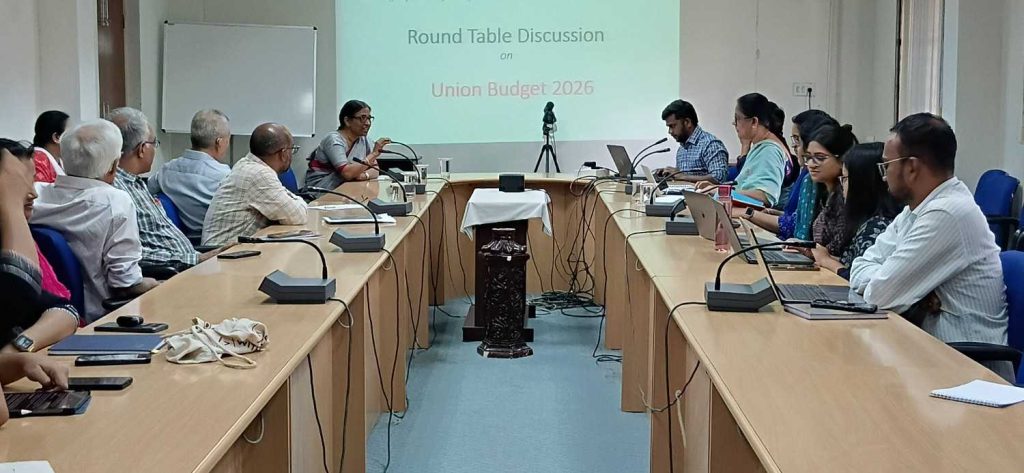
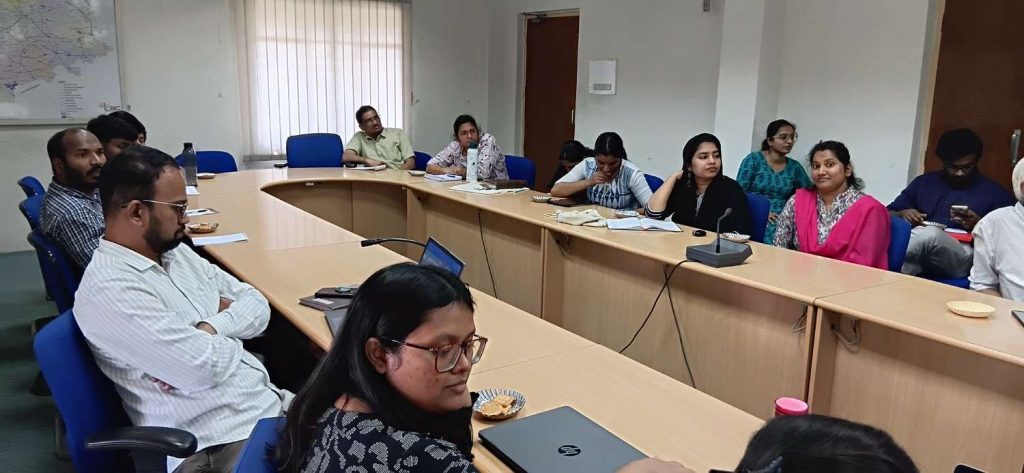
CESS–DGS organised a Round Table Discussion on the Union Budget 2026 on 17 February 2026. Dr. Alivelu Kasturi inaugurated the session by welcoming the participants and providing a brief overview of the objectives of the discussion.
Prof. E. Revathi presented a comprehensive overview of the Union Budget 2026. The Union Budget 2026 outlined the government’s macroeconomic vision and long-term policy direction, moving beyond annual numbers to signal structural reforms and development priorities. Overall, the budget reinforces infrastructure-driven growth under the broader vision of Viksit Bharat and Amrit Kaal 2047.
Prof. Amar Yumnam highlighted that the Budget’s affirmations regarding manufacturing, infrastructure, MSMEs, and initiatives such as Khelo India overlook the specific geographical realities of India’s South East Asian region. He noted that the lack of acknowledgement for the region’s achievements and potential is distinctly evident.
Dr. Vijay Korra noted the 2026–27 Union Budget’s shift to Agri-intelligence while expressing concerns over research funding cuts, stagnant PM-KISAN allocation, lack of an MSP law, and insufficient farm debt relief.
Ms. Priya Krishnan spoke on India’s 2026 Budget for startups, despite strong policy intent, suffers from poor implementation. Improving processing times and support can create a more inclusive startup ecosystem for national growth.
Ms. Mousumi Chatterjee highlighted the Budget’s focus on liquidity support, the Bio-Pharma Shakti initiative, and Semiconductor Manufacturing 2.0, aiming to bolster domestic manufacturing, improve technological self-reliance, and create a resilient ecosystem for startups.
Dr. Kasturi Alivelu noted the Budget’s boost for fintech and electronics manufacturing with ₹40,000 crore allocated. It emphasises support for clusters and Telangana’s Mega Master Plan, including infrastructure improvements and a ₹10,000 crore MSME fund. Key focus areas are e-marketplaces, startups, textiles, AI, and rationalised tax tariffs.
Dr. J. Srinivas emphasised that although the Budget allocates more for Employment and Skilling, implementation is inadequate. He stressed the need for increased investment in research and job-oriented education for meaningful outcomes.
Ms. Geeta Gantla noted a slight increase in education sector allocation to ₹1.39 lakh crore, supporting PM SHRI schools and university modernisation. She stressed enhancing higher education facilities and linking education to employability. Dr. M. Venkatanarayana emphasized public investment in education from KG to PG, deeming current student financing inadequate for human capital development.
Ms. Titir Sarkar spoke on Gender Budgeting and Women’s Economic Empowerment, noting that India’s 2026–27 Gender Budget stands at ₹5.01 lakh crore (9.37% of total expenditure). She highlighted its focus on livelihoods, care economy, skills, and women-led enterprises, while flagging gaps in implementation and outcome tracking.
Ms. Ch. SreeVidya noted the Budget’s focus on five green sectors, but utilisation is only 66%. Insufficient spending on wind energy and attention to women’s climate vulnerability reveal the need for improved Climate Action implementation.
Dr. V.Vijay Kumar reviewed the urban development aspects of the budget and showed that the budget focused on agglomerations. Further, he highlighted that the trend of increasing debt-linked reforms or the debt portion of the CSS would become a burden on the revenue-starved ULBs.
Dr. Y Sreenivasulu critiqued the Budget for prioritising corporate growth over caste, class, gender, and climate issues, highlighting rising wealth concentration and advocating for stronger social protection and progressive taxation for inclusive development.
The round table discussion on the Union Budget 2026–27 was marked by constructive deliberations and meaningful insights, with focused discussion on key policy areas.