
Hyderabad, January 29, 2026
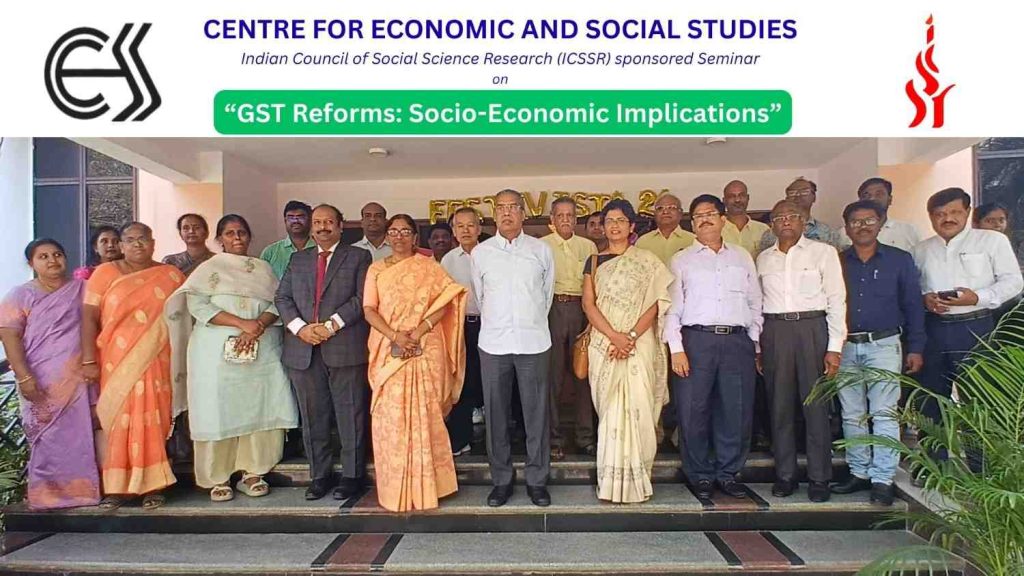
The Centre for Economic and Social Studies (CESS) organized ICSSR sponsored seminar titled “GST Reforms: Socio-Economic Implications”. The event brought together senior officials from the commercial tax department, state tax administrators and practitioners to evaluate the transition into “GST 2.0” and its impact on the economy, small businesses and state fiscal health.
Key Highlights & Administrative Insights While giving opening remarks, Dr. G.R. Reddy, Founder Member of CESS, traced the evolution of Indian fiscal federalism. He noted that while GST has moved India toward a unified market, it remains one of the world’s most complex systems, currently balancing social equity through multiple tax slabs rather than a single rate.
Sri M. Raghunandan Rao (IAS), Commissioner of Commercial Taxes, Telangana, delivered the lead address, emphasizing that GST is a “work in progress.” He highlighted the “Trust-First” philosophy of the regime, where 95% of taxpayers operate without intrusive scrutiny. However, he noted that the digital transformation via GSTN (GST Network) is one of the best digital products, and is now the “digital highway” for the nation’s economy, comparable in impact to Aadhaar and the railway reservation system. He also elaborated on the key challenges of GST such as “One tax and Two Administrations” and emphasized that further research is required to assess whether the objectives of the GST are met.
GST 2.0: The Three Pillars of Reform Sri K. Ravi (Joint Commissioner, CT) outlined the roadmap for GST 2.0, focusing on:
- Structural Reforms: Correcting the “Inverted Duty Structure” (where inputs are taxed higher than finished products) in sectors like textiles and fertilizers.
- Rate Rationalization: Moving toward a simplified two-slab structure (5% and 18%) while shifting luxury and “sin” goods to higher brackets.
- Process Simplification: Introducing auto-approval for registrations within three days and pre-filled returns to reduce the compliance burden on entrepreneurs.
Critical Issues & Challenges Raised The technical sessions highlighted several “red flags” that require urgent policy attention:
- Revenue Leakage and “Fake” Entities: Smt. Roopa Sowmya (Joint Commissioner, CT) warned of an “alarming” spike in suspicious registrations. She noted that while the 3-day approval window helps genuine businesses, it is being exploited by fraudulent elements to generate fake invoices.
- State Revenue Concerns: The shift to a consumption-based tax has benefited consuming states, but the expiration of the “Compensation Cess” and the introduction of new Central cesses (like the National Security Cess) are seen as potential blows to state finances.
- The “Exemption Trap”: Experts discussed how exempting life and health insurance, while a boon for the middle class, might inadvertently “trap” revenue in producing states (like Maharashtra) as the tax chain breaks before reaching consumption states like Telangana.
- The Compliance Paradox: Sri V.S. Sudhir (Chartered Accountant) highlighted the practitioner’s view, noting that while the law aims for simplicity, the constant need for data reconciliation and the risk of “blocked credits” still weigh heavily on Small and Medium Enterprises (SMEs).
Conclusion The seminar concluded that for GST to truly drive India toward a $30 trillion economy by 2047 and $ 3 million economy for Telangana, the “Trust-First” model must be reinforced by stronger backend data analytics to catch “black sheep” without penalizing honest taxpayers.
Prof. E. Revathi, Director of CESS, thanked the Commercial Tax Department of Telangana for their transparency and cooperation, noting that the findings from this seminar would inform a larger research project on GST’s impact on the youth and middle class.