
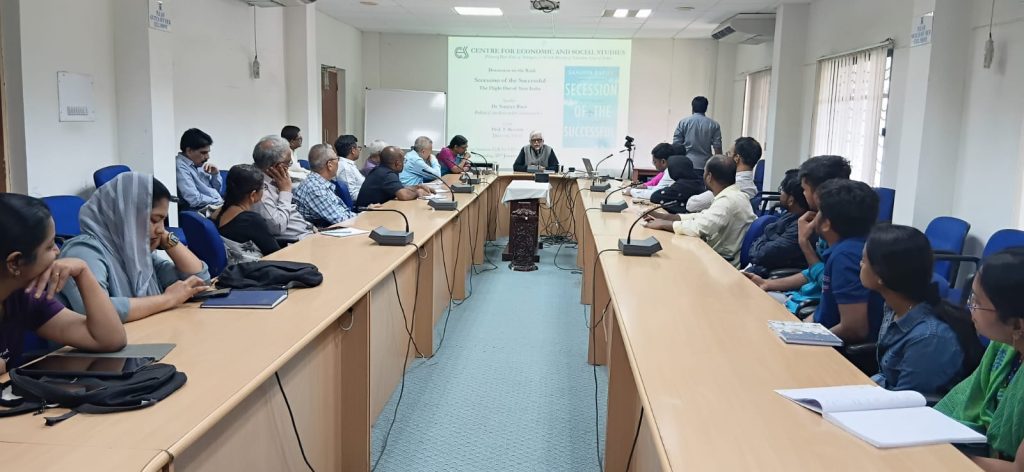
Book Discussion on “Secession of the Successful: The Flight Out of New India”
22nd January 2026
The Centre for Economic and Social Studies (CESS), Hyderabad, hosted a Book Discussion on Secession of the Successful: The Flight Out of New India by Dr Sanjaya Baru, political analyst and commentator. The discussion was chaired by Prof. Revathi, Director, CESS, who outlined the book’s analysis of the four major phases of emigration from India over the past two centuries—from nineteenth-century indentured labour migration, to migration to the Middle East following the oil boom, the large-scale movement of skilled professionals to advanced economies, and the recent emigration of economically successful and wealthy individuals relinquishing Indian citizenship.
The book notes that nearly 32 million Indians live across 210 countries, encompassing non-resident Indians as well as second-generation migrants, and examines migration through its economic, social, and cultural dimensions.
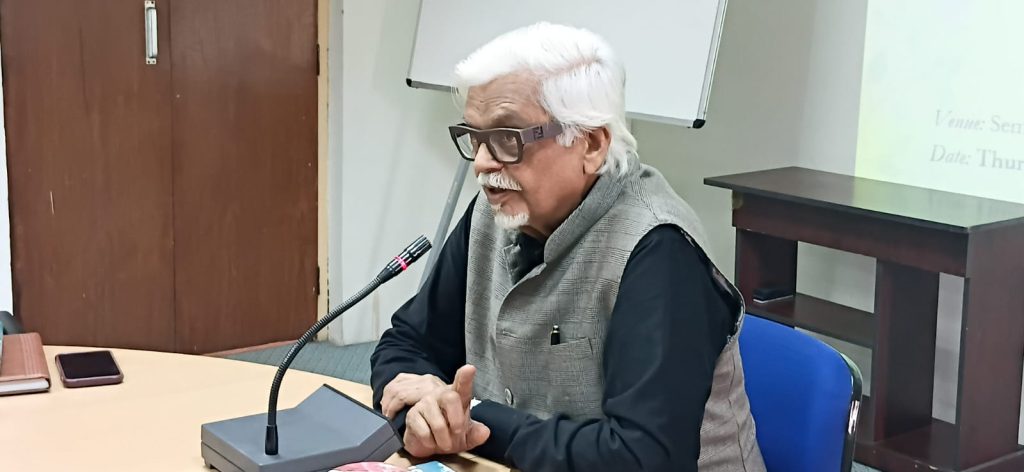
During the discussion, Dr Sanjaya Baru reflected on India’s role in the global movement of labour, skills, and wealth. He observed that while the post-Independence decades saw the return of many Indians educated abroad who contributed significantly to institution-building, subsequent decades witnessed increasing skilled emigration. Despite ongoing outflows of educated and skilled workers, the idea of brain drain has receded from public discourse. Dr Baru highlighted India’s inability to generate adequate and decent employment for its skilled workforce and characterised the contemporary emigration of high-net-worth individuals as a form of “wealth drain.”
The discussion also touched upon debates on dual citizenship, the evolution of PIO and OCI statuses, and the broader implications of migration and mobility. Dr Baru urged scholars and researchers to engage more deeply with the emerging social, economic, and global questions raised by these trends.